Recent Posts
Archives
Unsung Hero of Digital Success: Product Data Scientist
In today’s digital economy, data is no longer a support function but, the core driver of product innovation, growth and competitive edge. Think about apps like Spotify, Netflix, Airbnb, Uber or any SaaS platforms you may know, that are looking to launch new exciting features. If you have ever wondered how Netflix knows exactly what show to recommend next, or why Uber’s platform is so intuitive, then you’re looking at the handiwork of an individual in their data team. These companies not only rely on data to understand what happened but also to decide what to build next.
If you have been in data science for a while or just starting out, you have probably heard about the hype phrases “data is the new oil” or “data science is the sexiest job of the 21st century“. Well somewhere between all this and the reality of most data teams on ground, a quieter and more focused specialisation has emerged. One that does not just involve analysing data and building models, but is directly shaping the products that millions of people are using everyday. This role is the Product Data Scientist.
If you work in tech, whether you are a product manager, engineer, technical recruiter, founder or an aspiring data professional, understanding what this professional does and why they matter in your business moving forward, will fundamentally change how you think when building digital products.
This guide covers everything from definition, the day-to-day, skills, how the role differs from the traditional data scientist, other industry names it goes by and why the most data driven product teams in the world treat this role as an essential infrastructure.
Who is a Product Data Scientist?
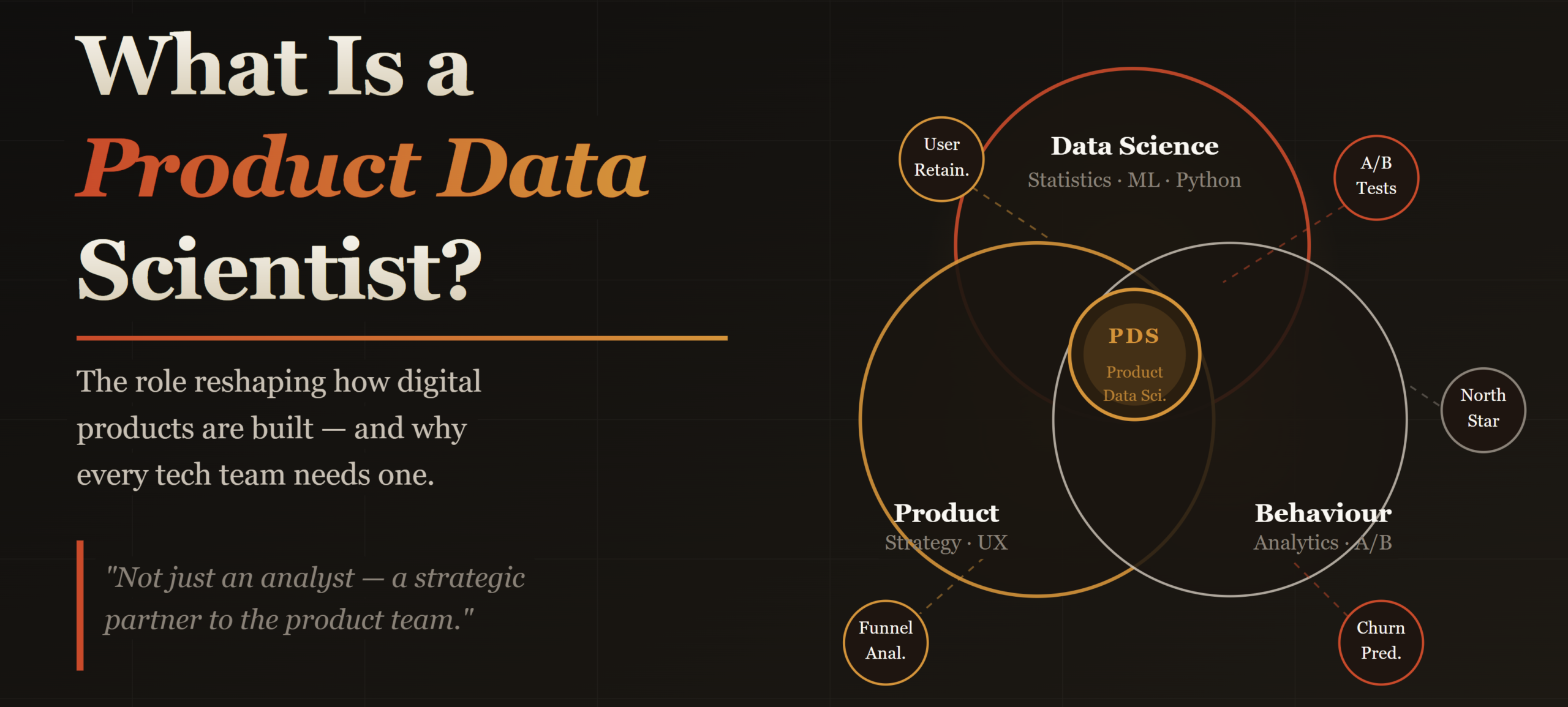
A Product Data Scientist (PDS) is a data professional who sits at the intersection of data science, product management and business strategy, using data to directly influence how digital products are designed, improved and scaled. They are focused on improving digital products through data driven insights, experimentation and decision making. Their work is based around understanding how users interact with a product, measuring whether the product is working and generating insights that guide product decision and impact user experience.
Unlike a traditional data scientist, like those in research or operations, they don’t just build models, but are embedded in the product development lifecycle. They work alongside product managers, UX designers and software engineers. Their mission is to answer questions like:
- How are users behaving ? (e.g. Why are users dropping off during onboarding?)
- Why are they behaving that way ?
- Which feature increases retention?
- What drives revenue or engagement?
What should we build next?
The easiest way to understand this role is, everything a product data scientist does from building dashboards, running experiments, segmenting users and building predictive models, ultimately is in understanding and improving a set of metrics that define whether the product is creating value for its users and the business.
A product data scientist is not just someone who analyses product data. They are strategic partner to the product team and the business, improving the product's performance, user experience and business value.
Traditional Data Scientist vs Product Data Scientist
A traditional data scientist focuses on models, algorithms, and predictions. A product data scientist focuses on product decisions and user behavior.
|
Dimension
|
Traditional DS
|
Product DS
|
|---|---|---|
|
Primary Focus
|
User behaviour, product performance, feature outcomes
|
User Behavior, Experimentation, Feature Adoption.
|
|
Key Stakeholders
|
Finance, operations, executive leadership, research teams
|
Product managers, designers, engineers, growth teams
|
|
Key Questions
|
"Can we predict customer churn?" "How do we optimize the recommendation algorithm?"
|
"Why did the onboarding flow drop by 10%?" "Did the new signup button actually increase retention?"
|
|
Work Cadence
|
Long-horizon projects (months); research-driven
|
Sprint-aligned (days to weeks); iterative, fast-paced
|
|
Core Tools
|
Python/R, ML frameworks, statistical modelling, data warehouses
|
Product analytics (Mixpanel, Amplitude), A/B testing, SQL, dashboards
|
|
Success Metric
|
Model accuracy, forecast precision, business ROI
|
Product KPI improvement, experiment velocity, product decision quality
|
|
Typical Output
|
Models, reports, data pipelines, research papers
|
Experiment results, user insights, metric frameworks, product recommendations
|
|
ML Usage
|
Builds, trains, deploys models
|
Uses ML where it serves product goals (recommendation, personalisation, churn prediction)
|
|
User Proximity
|
Often indirect; user is an abstraction
|
Direct; deep empathy for user journeys and product experience
|
It is worth noting that these roles are not mutually exclusive, and many data professionals move between them. But understanding the distinction is critical for companies that want to build the right team and for data professionals who want to understand where their skills are best applied.
Traditional data scientists are often optimising systems. Product data scientists are optimising experiences. The former thinks in models and pipelines. The latter thinks in user journeys and decision loops.
Core Responsibilities of a Product Data Scientist
The day-to-day work of a product data scientist is varied. No two weeks look exactly alike, but the work clusters around five core responsibilities:
1. Defining and owning product metrics
Before you can improve a product, you need to measure it. Product data scientists are often responsible for designing the metric frameworks that tell a product team whether they are succeeding. This includes defining north star metrics (the single number that best captures product value), guardrail metrics (metrics you can not let degrade), and diagnostic metrics (the leading indicators that explain why the north star moves).
2. Experimentation and A/B Testing
Product data scientists design, execute, and analyse controlled experiments like A/B tests, multivariate tests, holdout groups that allow product teams to make causal claims about what works. This requires not just statistical knowledge, but the practical wisdom to know when an experiment is well-designed, when results are trustworthy, and when a team is reading too much into noise. At scale, product data scientists often own the entire experimentation platform and design.
3. User behaviour analysis
Qualitative and quantitative investigation into how users move through a product. This includes funnel analysis (where are users dropping off?), retention analysis (why do users come back or not?), cohort analysis (do newer users behave differently than older ones?), and segmentation (are there meaningfully different user types who need different things?). The goal of the Product Data Scientist is always to generate actionable insight, not just interesting observation.
4. Predictive Modelling for product use cases
Unlike traditional ML roles, a product data scientist’s modelling work is tightly scoped to product outcomes. Common applications include churn prediction (which users are at risk of leaving?), recommendation systems (what should we show this user next?), personalisation engines (how do we tailor the experience by user segment?), and lifetime value modelling (which users are most valuable, and how do we acquire more of them?). The emphasis is on models that feed directly into product decisions or product systems.
5. Product strategy partnership
The best product data scientists are not analysts sitting behind a dashboard. They are strategic partners to the product team. They attend roadmap reviews, challenge assumptions, bring data to prioritisation debates, and help the team understand the “why” behind what the numbers are showing. They translate the language of data into the language of product decisions, and vice versa.
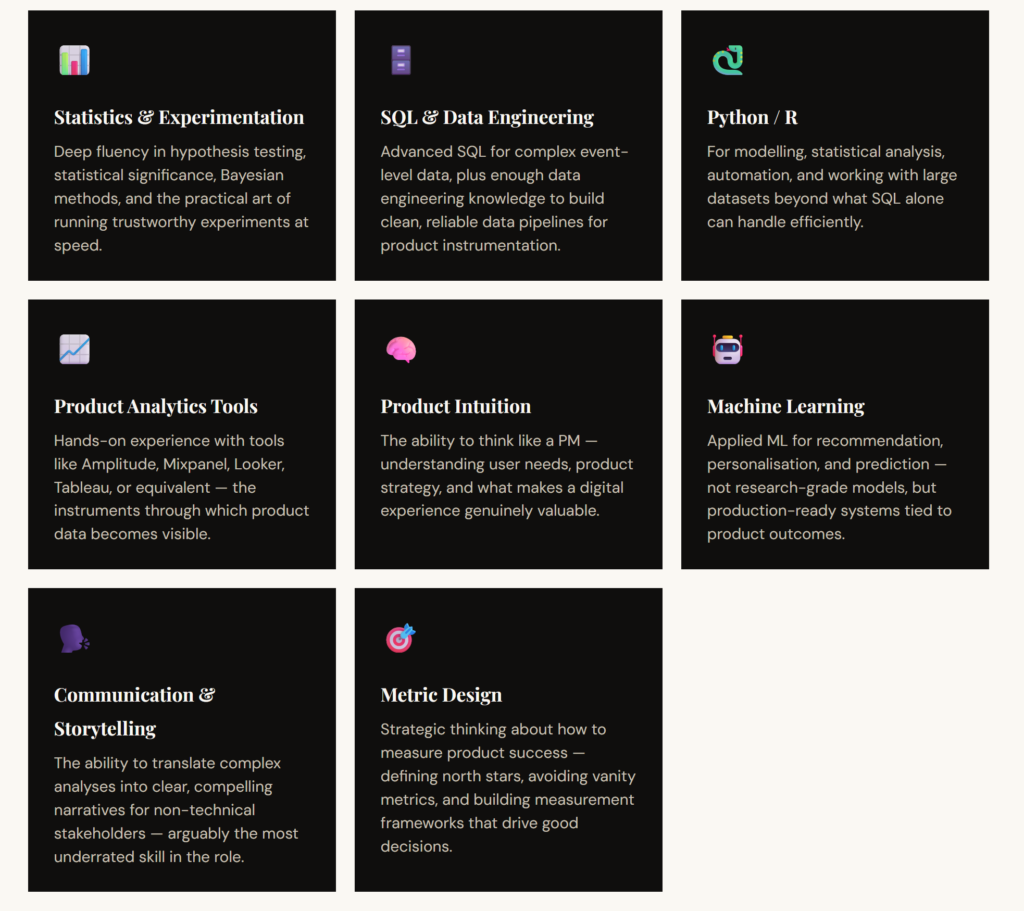
Core skills for an experienced PDS
Becoming a Product Data Scientist requires a unique blend of hard technical skills, product intuition and business acumen.
Other titles in the industry
- Data Scientist – Product
- Product Analyst
- Senior Product Analyst
- Quantitative UX Researcher
- Product Intelligence Analyst
- Behavioural Data Scientist
- Product Insights Manager
- Applied Scientist – Product
The key takeaway is to always look at the job description, not just the title. If the role involves experimentation, user behaviour analysis, and close collaboration with product managers, regardless of what it’s called, then you’re looking at a product data scientist role.
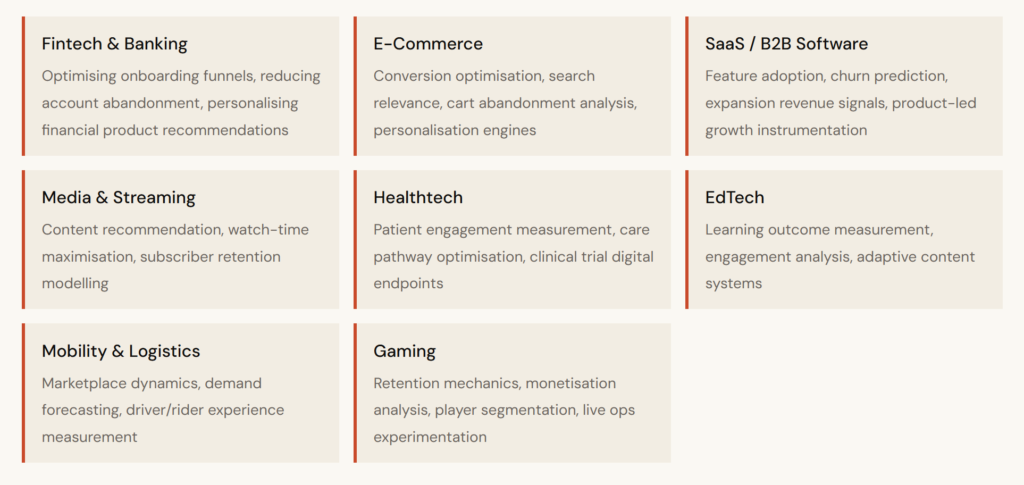
How the role shapes Digital Products across Industries
In each of the industries, the value proposition is the same. A product data scientist ensures that product decisions are grounded in evidence rather than opinion.
If your product team is making major decisions without a dedicated product data scientist, you are likely leaving significant value on the table. Not because you lack smart people, but because you lack the structured measurement infrastructure to know whether your business intuitions are right.
This role is increasingly the baseline for any team that takes product quality and management seriously.
✦ Through my data lens ✦
Digital products are not built in a vacuum. They are built by humans, for humans, within a competitive landscape that punishes complacency and rewards learning. The product data scientist is the professional the industry evolved to close the loop between what users do and what teams decide to build. I would not say we are magicians, but we are rigorous, curious, product-minded professionals who have mastered the art of turning messy behavioural data into clear, decision-ready insight at the speed that modern product teams require.
If you are a professional considering this path all I can say is, the demand is real, the work is genuinely interesting, and the impact is visible in every product you improve. If you are a leader building a product team, then this role is not optional. It is the connective tissue between your product strategy and reality.
And if you are simply trying to understand the modern digital product landscape, all I can say is, this role is one of the clearest windows into how the best companies actually make decisions. The products you use daily from the recommendation engines, the personalised feeds, the features that feel like they were built specifically for you, those are the fingerprints of product data science done well.